
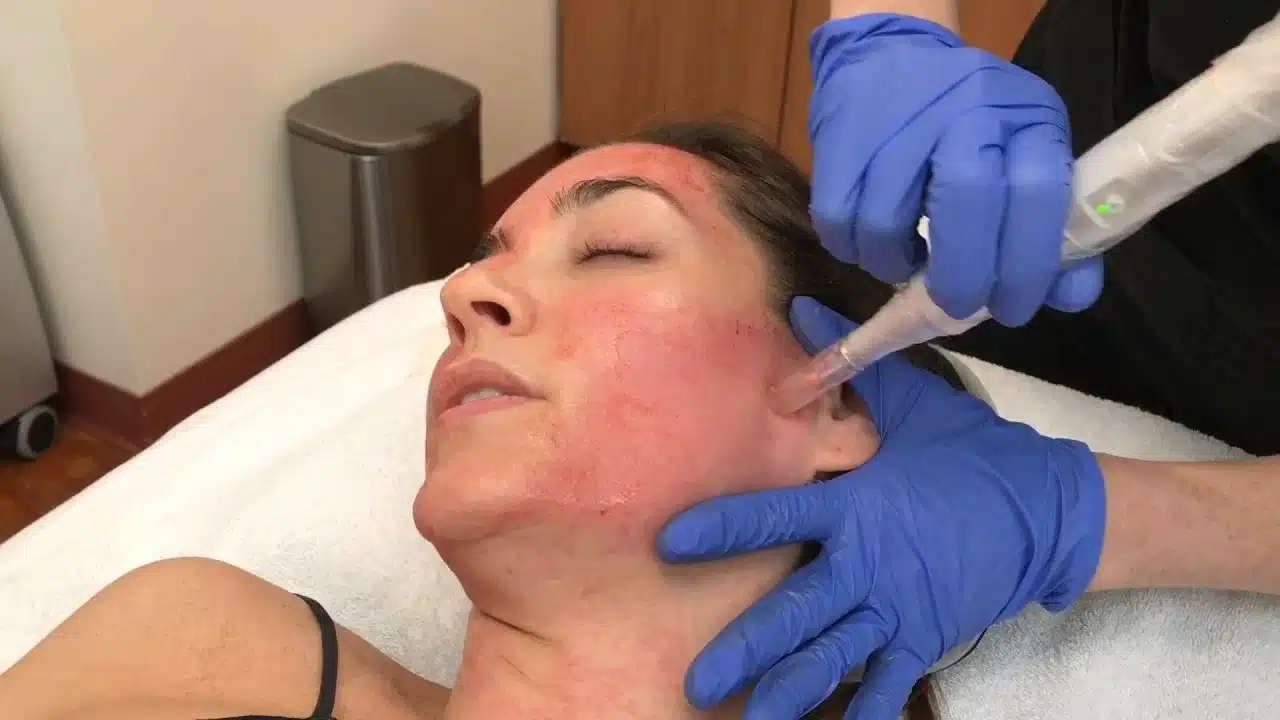
In the ever-evolving world of aesthetic medicine, the quest for natural, effective skin rejuvenation has led to exciting advancements in treatments that harness your body’s own healing power. Among these, microneedling combined with platelet-rich therapies has emerged as a game-changer. But a new question arises: PRF vs PRP microneedling, which approach delivers superior results?
Both PRF and PRP microneedling use growth factors from your own blood to boost collagen. PRP delivers an immediate burst of growth factors and results that last around 6 to 12 months. PRF uses no additives and a natural fibrin matrix that releases growth factors gradually over 7 to 14 days, giving deeper, longer-lasting results of roughly 12 to 18 months.
This guide breaks down everything you need to know about these two innovative treatments, helping you make an informed decision for your skin health journey. Both use components from your own blood to stimulate healing and collagen production, but they differ in preparation and how they deliver results.
What Are PRP and PRF? Understanding the Science
PRP (Platelet-Rich Plasma) is a concentrated substance derived from your blood through a centrifugation process. A small amount of blood is drawn, placed in a tube with anticoagulants, and spun at high speed to separate the platelet-rich plasma layer, which is packed with the growth factors that drive healing and tissue regeneration.
PRF (Platelet-Rich Fibrin) is the next evolution. It uses a slower spin and no anticoagulants, which allows a natural fibrin matrix to form, a three-dimensional scaffold that traps platelets, white blood cells, and stem cells. That network creates a sustained-release system for longer-lasting stimulation.
The fundamental distinction comes down to delivery: PRP releases growth factors immediately, while PRF creates a biological scaffold that releases them gradually, mimicking the body’s natural healing more closely.
How the Microneedling Process Works
The combination of microneedling with platelet-rich therapies creates a powerful synergy. Here is what to expect:
- Consultation and preparation. Your provider assesses your skin, and a topical numbing cream is applied for comfort.
- Blood draw. A small amount of blood (about 15 to 30 ml) is drawn, similar to a standard blood test.
- Centrifugation. PRP is spun fast (2,000 to 3,000 RPM) with anticoagulants; PRF is spun slower (1,200 to 1,500 RPM) without them to form the fibrin matrix.
- Microneedling. A sterile device creates microscopic channels in the skin, triggering collagen induction therapy.
- Application. The concentrated platelet solution is applied to the freshly microneedled skin.
The entire process typically takes 60 to 90 minutes, with minimal discomfort thanks to the numbing cream.
PRF vs PRP Microneedling: Key Differences
| Feature | PRP Microneedling | PRF Microneedling |
|---|---|---|
| Additives | Uses anticoagulants | 100% natural, no additives |
| Centrifugation Speed | Fast spin (2,000 to 3,000 RPM) | Slow spin (1,200 to 1,500 RPM) |
| Growth Factor Release | Immediate burst | Slow and sustained (7 to 14 days) |
| White Blood Cells | Minimal | Significant concentration |
| Fibrin Matrix | No natural scaffold | Rich 3D fibrin network |
| Platelet Concentration | High | Moderate but more natural |
| Results Duration | 6 to 12 months | 12 to 18 months |
| Cost Per Session | $500 to $900 | $700 to $1,200 |
PRF’s slower centrifugation preserves more white blood cells for healing, and its fibrin matrix acts as a natural scaffold that prolongs growth-factor release while supporting the skin structurally. PRF also traps stem cells, which may enhance its regenerative effects beyond what PRP can achieve.
Benefits of PRF Microneedling
- Natural collagen and elastin production. Sustained release continuously stimulates the fibroblasts that produce collagen and elastin for gradual, natural-looking firmness.
- Longer-lasting results. Many patients enjoy improved skin quality for 12 to 18 months before maintenance.
- Comprehensive improvement. Addresses texture, fine lines, acne scars, and uneven tone at once.
- 100% natural, no additives. No anticoagulants means only your body’s own healing components, reducing reaction risk.
- Enhanced wound healing. A high concentration of white blood cells adds anti-inflammatory and antimicrobial support.
- Superior structural support. The fibrin scaffold supports regeneration for depressed scars and laxity.
Benefits of PRP Microneedling
- Proven track record. Used in dermatology for over 15 years with well-documented safety and efficacy.
- Immediate growth factor release. Many patients notice improved radiance and texture within the first few weeks.
- Lower cost point. A more budget-friendly entry into platelet-enhanced microneedling.
- Great for mild to moderate concerns. Effective for early aging and mild texture issues.
- Shorter processing time. The faster spin means less wait during your appointment.
Which One Is Better? Making the Right Choice
The best choice depends on your concerns, budget, and desired outcomes. For most patients, PRF offers longer-lasting results and deeper rejuvenation. But PRP remains an excellent choice for first-time patients, those with budget constraints, milder concerns, and younger patients focused on prevention.
PRF tends to be more beneficial for those seeking maximum results and longevity, addressing deep wrinkles or pronounced scarring, and wanting the most natural, additive-free approach. Some practices even combine both in one session to leverage PRP’s immediate release and PRF’s sustained benefits.
Results and Recovery: What to Expect
- Days 1 to 3. Skin appears red and flushed like a moderate sunburn, usually subsiding within 24 to 72 hours.
- The first week. Redness fades and skin may feel dry and peel slightly. Use gentle, hydrating products and skip exfoliants.
- Visible improvements. Radiance and texture improve within 2 to 3 weeks; fine lines, pores, and tightness around 4 to 6 weeks.
- Long-term transformation. The most dramatic results develop over 2 to 3 months. Many patients do a series of 2 to 3 treatments spaced 4 to 6 weeks apart.
Consistent skincare, daily sunscreen, and hydration protect and extend your results. Many clients also pair microneedling with skin booster treatments or a hydrating hydrodermabrasion facial to support hydration and glow between sessions.
PRF vs PRP Cost
- PRP microneedling averages $500 to $900 per session; a series of 2 to 3 runs about $1,000 to $2,700.
- PRF microneedling typically runs $700 to $1,200 per session; a series of three runs about $2,100 to $3,600.
Cost is influenced by provider expertise, location, treatment area, and the device used. While PRF costs more up front, its longer-lasting results can make it more cost-effective over time.
Who Is a Good Candidate?
Good candidates include those with fine lines, dull skin, mild to moderate laxity, or acne scars who want a natural alternative to synthetic dermal fillers and have realistic expectations. Poor candidates include those with active skin infections, blood disorders, those on blood thinners without clearance, a history of keloid scarring, or who are pregnant or breastfeeding. A thorough consultation confirms the right fit. If your skin is sensitive or rosacea-prone, read our guide on microneedling with rosacea before booking.
Ready for the Next Generation of Natural Skin Repair?
Book a consultation and our team will assess your skin and recommend whether PRP, PRF, or another rejuvenation treatment best fits your goals. Explore our laser facial options and the benefits of our salmon sperm facial, or ask about combining treatments.
Book Your ConsultationFrequently Asked Questions
Is PRF better than PRP for microneedling?
For most patients seeking optimal, long-lasting results, PRF offers advantages due to its sustained growth-factor release and natural composition. PRP remains effective, particularly for milder concerns or budget-conscious patients. The better option depends on your goals and skin condition.
How long do PRF microneedling results last?
PRF results typically last 12 to 18 months, varying with age, skin condition, and how many treatments you have had. Collagen remodeling provides lasting improvement even after the growth factors dissipate.
Can I combine PRF with other treatments?
Yes. Common combinations include PRF with radiofrequency microneedling for tightening, or with laser treatments such as a carbon laser facial for comprehensive rejuvenation. For more pronounced sagging, a PDO thread lift may be recommended alongside. These should be performed by experienced practitioners.
Is PRF microneedling painful?
Most patients describe it as manageable rather than painful. A topical numbing cream is applied first, and afterward the skin feels warm and sensitive, similar to a sunburn, usually resolving within a day.
How many sessions are recommended?
Most providers recommend an initial series of 2 to 3 treatments spaced 4 to 6 weeks apart, followed by maintenance every 6 to 12 months for PRP or 12 to 18 months for PRF.
Bottom Line
Both PRF and PRP microneedling harness your body’s natural healing to rejuvenate skin, but they differ in approach and longevity. The best choice depends on your individual concerns, budget, and expectations. Consulting an experienced, qualified provider who understands both technologies is the most important step in deciding which is right for you.
Comments are closed